.png)


The Evolution of POS: How Apple & Google Turned NFC Into a Checkout Revolution
From Cash Registers to Contactless Control
Walk into any café today and watch how people pay.
No cash drawer.
No clunky card terminal.
Just a phone tap and it’s done.
This didn’t happen overnight.
The Point of Sale (POS) has gone through a quiet but brutal evolution. What started as mechanical cash registers became cloud software platforms and now, thanks to NFC reader modules embedded directly into smartphones, POS hardware itself is disappearing.
At the center of this shift? Apple and Google.
Here’s the deal:
They didn’t just improve payments.
They redefined who can accept payments, where, and at what cost.
Let’s break it down clearly, chronologically, and without fluff.
The Original POS Era: Fixed, Expensive, and Slow
The first POS systems were simple:
- Cash register
- Receipt printer
- Human cashier
That was it.
Later came electronic POS terminals in the 1980s–1990s, followed by card acceptance.
But they had major flaws:
- Hardware-heavy (terminals, pin pads, cables)
- High upfront costs
- Vendor lock-in
- Limited mobility
If you wanted to accept cards, you needed:
- A bank
- A merchant account
- Certified hardware
- Installation
- Maintenance contracts
In short: payments were controlled by institutions, not merchants.
The Shift to Digital POS Software
Then software ate the POS.
Cloud-based systems like Square and others introduced:
- Tablets instead of terminals
- App-based checkouts
- Cloud reporting
- Remote updates
This was progress but the card reader was still a dependency.
You still needed:
- A dongle
- A terminal
- An external NFC reader
Hardware was smaller but not gone.
And that bottleneck mattered.
Enter NFC: The Technology That Changed Everything
What NFC Actually Did
Near Field Communication (NFC) allowed:
- Contactless cards
- Mobile wallets
- Secure tokenized payments
- Faster checkout
But early NFC adoption still relied on external readers.
The real breakthrough wasn’t NFC itself.
It was who controlled the NFC chip.
Apple’s Move: NFC as a Platform, Not a Feature
Apple played the long game.
For years, the NFC chip inside the iPhone was locked down usable only for Apple Pay.
Developers complained. Regulators pressured. Merchants waited.
Then Apple flipped the table.
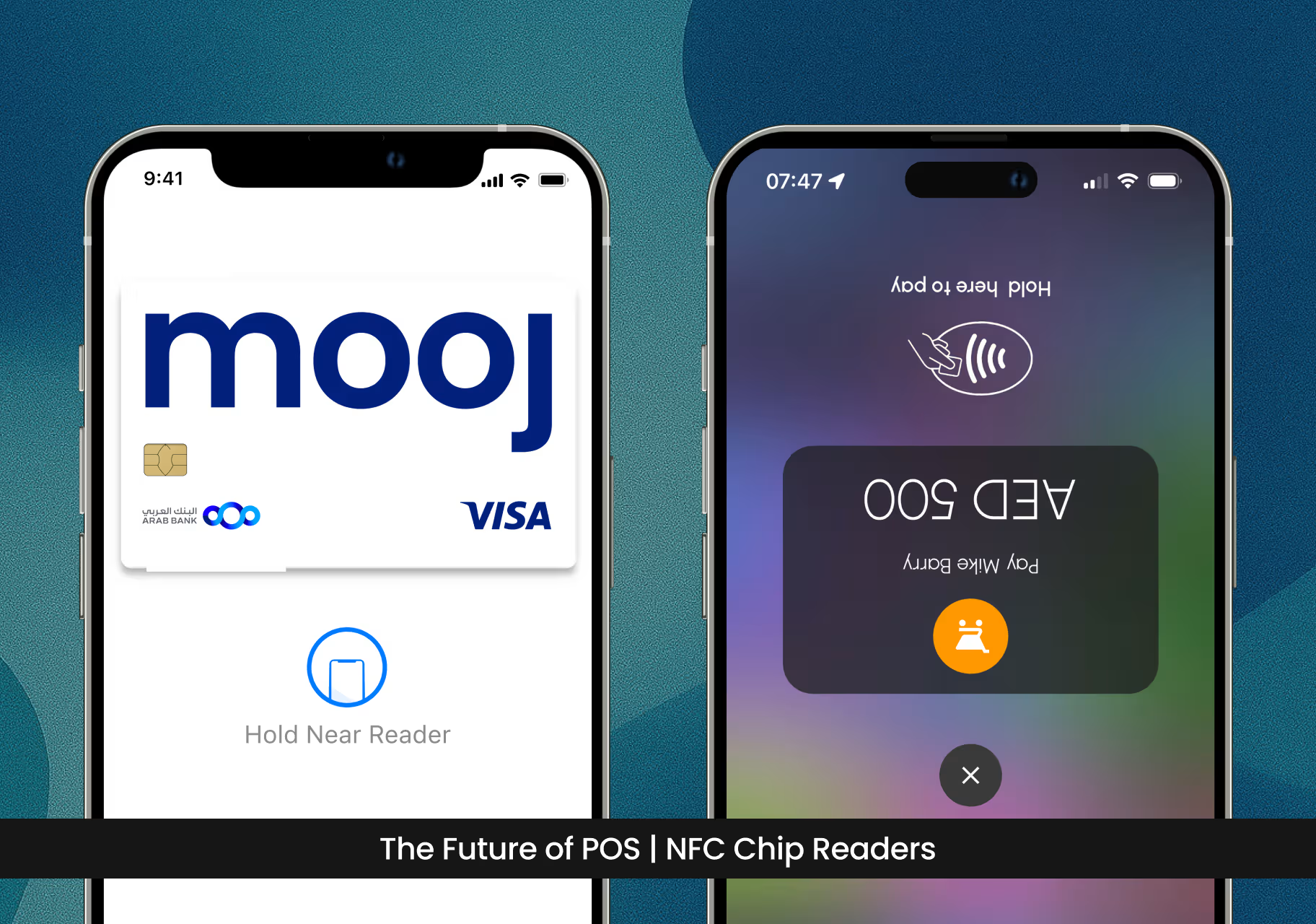
Apple Tap to Pay on iPhone
Apple introduced Tap to Pay on iPhone, allowing:
- iPhones to act as full NFC payment terminals
- No external hardware
- No dongles
- No card readers
- Just software
This meant:
- A merchant could accept payments using only an iPhone
- EMV-grade security
- PCI compliance handled by Apple
Why this mattered:
- Hardware cost dropped to zero
- Onboarding friction collapsed
- Micro-merchants suddenly became viable
Here’s the truth:
Apple didn’t build a feature.
They deleted an entire hardware category.
Google’s Approach: Open, Scalable, Everywhere
Google took a different path but reached the same destination.
Tap to Pay on Android
Google enabled NFC payment acceptance across:
- Android phones
- Android tablets
- Multiple OEMs
Key differences:
- Broader device support
- Faster regional rollout
- Deeper customization for developers
Android’s model favored:
- Emerging markets
- SMBs
- Field merchants
- Logistics and delivery use cases
In many regions, Android-based NFC POS arrived before traditional terminals.
That’s not an upgrade.
That’s a leapfrog.
Why Phone-Based NFC POS Changed the Economics
This is the part most people miss.
Removing hardware didn’t just simplify payments it restructured the entire POS business model.
Before NFC-on-Phone
- Hardware margin mattered
- Deployment was slow
- Support was expensive
- Only serious merchants applied
After NFC-on-Phone
- Software-first economics
- Instant onboarding
- Global scalability
- Anyone can become a merchant
This is why:
- Super-apps integrated POS
- Fintechs moved faster than banks
- Payments embedded into workflows
POS stopped being a “system”
and became a capability.
Security: The Objection That Didn’t Hold
Naturally, people asked:
“Isn’t accepting payments on a phone less secure?”
The answer is no and here’s why:
- Secure Enclave (Apple)
- Hardware-backed keystores (Android)
- Tokenization
- No card data stored
- Dynamic cryptograms per transaction
In practice:
- Phone-based NFC is often more secure than cheap terminals
- Compliance is abstracted away from the merchant
- Fraud detection is OS-level, not app-level
Security became invisible and that’s exactly the point.
The New POS Stack: What It Looks Like Today
Modern POS is no longer a box on a counter.
It’s a stack:
- Device: Smartphone
- OS: iOS / Android
- NFC Reader: Embedded
- Wallets: Apple Pay, Google Pay, contactless cards
- Software: POS app + backend APIs
- Data: Real-time, cloud-native
And the merchant experience?
- Download app
- Verify identity
- Start accepting payments
Minutes, not weeks.
What This Means for Merchants
If you’re a merchant, this evolution means:
- Lower startup costs
- Faster go-to-market
- Mobility by default
- No hardware maintenance
- Easier expansion across locations
Street vendors, pop-ups, consultants, taxis, delivery drivers everyone becomes POS-enabled.
That’s not convenience.
That’s financial inclusion via software.
What This Means for Fintechs and Platforms
For fintech builders, the implications are even bigger:
- POS becomes a feature, not a product
- Payments embed into:
- Messaging apps
- Marketplaces
- CRM tools
- Vertical SaaS
NFC-on-phone enables:
- Agentic commerce
- AI-driven checkout
- Invisible payments
- Contextual transactions
POS is no longer the end of the journey.
It’s the start of the data loop.
The Real Shift: POS Is Now Identity-Driven
Here’s the deeper change most articles miss.
Traditional POS = transaction-centric
Modern POS = identity-centric
With Apple and Google controlling:
- Device identity
- User authentication
- Secure hardware
POS becomes:
- Tied to a person
- Context-aware
- Software-defined
That’s why:
- Loyalty integrates natively
- Receipts are digital
- Refunds are instant
- Analytics are real-time
Payments stopped being dumb pipes.
They became intelligent touchpoints.
What Comes Next
The next evolution is already forming:
- NFC + biometrics
- AI-assisted checkout
- Voice-initiated payments
- Embedded finance inside non-financial apps
- POS without a “checkout moment”
Apple and Google didn’t just modernize POS.
They made it disappear into the background.
And once something becomes invisible it scales infinitely.
Conclusion: The POS Revolution Was Software, Not Hardware
Let’s be blunt.
The biggest POS innovation of the last decade wasn’t:
- Faster terminals
- Better screens
- Smaller readers
It was this:
Turning every smartphone into a secure, compliant, global payment terminal.
Apple and Google didn’t compete with POS vendors.
They outgrew the category.
And the winners going forward?
- Software-first merchants
- Embedded finance platforms
- Fintechs that think beyond “checkout”
POS is no longer a place.
It’s a capability.
Call to Action
If you’re building, selling, or scaling a payment-enabled product:
- Rethink POS as software, not hardware
- Design for NFC-first, phone-native experiences
- Treat checkout as data + identity, not just payment
And if this article sharpened your thinking, share it with someone still stuck buying terminals.